
Dr. Lin Recent Publications
- FlashSchNet: Fast and Accurate Coarse-Grained Neural Network Molecular Dynamics. Pingzhi Li, Hongxuan Li, Zirui Liu, Xingcheng Lin, Tianlong Chen. ICML, 2026.
Abstract: Graph neural network (GNN) potentials such as SchNet improve the accuracy and transferability of molecular dynamics (MD) simulation by learning many-body interactions, but remain slower than classical force fields due to fragmented kernels and memory-bound pipelines that underutilize GPUs. We show that a missing principle is making GNN-MD IO-aware, carefully accounting for reads and writes between GPU high-bandwidth memory (HBM) and on-chip SRAM. We present FlashSchNet, an efficient and accurate IO-aware SchNet-style GNN-MD framework built on four techniques: (1) flash radial basis, which fuses pairwise distance computation, Gaussian basis expansion, and cosine envelope into a single tiled pass, computing each distance once and reusing it across all basis functions; (2) flash message passing, which fuses cutoff, neighbor gather, filter multiplication, and reduction to avoid materializing edge tensors in HBM; (3) flash aggregation, which reformulates scatter-add via CSR segment reduce, reducing atomic writes by a factor of feature dimension and enabling contention-free accumulation in both forward and backward passes; (4) channel-wise 16-bit quantization that exploits the low per-channel dynamic range in SchNet MLP weights to further improve throughput with negligible accuracy loss. On a single NVIDIA RTX PRO 6000, FlashSchNet achieves 1000 ns/day aggregate simulation throughput over 64 parallel replicas on coarse-grained (CG) protein containing 269 beads (6.5x faster than CGSchNet baseline with 80% reduction of peak memory), surpassing classical force fields (e.g. MARTINI) while retaining SchNet-level accuracy and transferability.
- Biophysical modeling for accurate T cell specificity prediction of viral and tumor antigens. Zahra S. Ghoreyshi, Noah Tubo, Luca Zammataro, Xizeng Mao, Ho Ngai, Duncheng Wang, Yibin Chen, Qiuming He, Eduardo Cisneros, Shoudan Liang, Priya J. Koppikar, Xingcheng Lin, Jeffrey J. Molldrem, Jason T. George. Nat. Commun., 23 June 2026. DOI: doi.org/10.1038/s41467-026-74236-0.
Abstract: We develop and apply a dual experimental and computational framework to predict antigen specificity of TCR sequences in serial clinical samples. Our model integrates TCR primary sequences with previously reported and in silico-derived TCR-pMHC structural data. We apply this approach in the setting of hematopoietic stem cell transplant, focusing on a collection of HLA-A*02-restricted epitopes, including the Melan-A tumor associated antigen (ELAGIGILTV), Influenza A virus M1_{58-66}-derived peptide (GILGFVFTL), and human cytomegalovirus pp65-derived peptide (NLVPMVATV). We demonstrate accurate prediction of specificity for previously uncharacterized donor- and patient-derived TCRs, wherein model performance is enhanced through sequence-based clustering and incorporation of structurally diverse templates. Our results demonstrate that structure-guided learning enables robust specificity prediction from limited training data and can generalize across sequentially obtained patient samples. This framework provides a scalable strategy for TCR specificity prediction with potential applications in immunotherapy, vaccine design, and immune monitoring.
- Active regulation of the epidermal growth factor receptor by the membrane bilayer. Shwetha Srinivasan, Xingcheng Lin, Xuyan Chen, Raju Regmi, Bin Zhang, Gabriela S Schlau-Cohen. eLife, 14 April 2026. DOI: doi.org/10.7554/eLife.108789.3.
Abstract: Cell surface receptors transmit information across the plasma membrane to connect the extracellular environment to intracellular function. While the structures and interactions of the receptors have been long established as mediators of signaling, increasing evidence suggests that the membrane itself plays an active role in both suppressing and enhancing signaling. Identifying and investigating this contribution has been challenging owing to the complex composition of the plasma membrane. We used cell-free expression to incorporate the epidermal growth factor receptor (EGFR) into nanodiscs with defined membrane compositions and characterized ligand-induced transmembrane conformational response and interactions with signaling partners using single-molecule and ensemble fluorescence assays. We observed that both the transmembrane conformational response and interactions with signaling partners are strongly lipid dependent, consistent with previous observations of electrostatic interactions between the anionic lipids and conserved basic residues near the membrane adjacent domain. Strikingly, the active conformation of EGFR and high levels of ATP binding were maintained regardless of ligand binding with high anionic lipid content typical of cancer cells, where EGFR signaling is enhanced. In contrast, the conformational response was suppressed in the presence of cholesterol, providing a mechanism for its known inhibitory effect on EGFR signaling. Our findings introduce a model of EGFR signaling in which the lipid environment can override ligand control, providing a biophysical basis for both robust EGFR activity in healthy cells and aberrant activity under pathological conditions. The membrane-adjacent protein sequence, likely responsible for the lipid dependence, is conserved among receptor tyrosine kinases, suggesting that active regulation by the plasma membrane may be a general feature of this important class of proteins.
- Nucleosome condensate and linker DNA alter chromatin folding pathways and rates. Yunrui Qiu, Shuming Liu, Xingcheng Lin, Ilona Christy Unarta, Xuhui Huang, Bin Zhang. Biophysical Journal, Volume 125, Issue 1, 6 Jan. 2026. DOI: doi.org/10.1016/j.bpj.2025.11.2686.
Abstract: Chromatin organization is essential for DNA packaging and gene regulation in eukaryotic genomes. While significant progresses have been made, the exact molecular arrangement of nucleosomes remains controversial. Using a well-calibrated residue-level coarse-grained model and advanced dynamics modeling techniques, particularly the non-Markovian dynamics model, we map the free energy landscape of tetra-nucleosome systems, identify both metastable conformations and intermediate states in folding pathways, and quantify the folding kinetics. Our findings show that chromatin with 10n basepair (bp) DNA linker lengths favors zigzag fibril structures. However, longer linker lengths destabilize this conformation. When the linker length is 10n+5 bp, chromatin loses the unique dominant conformation, favoring a dynamic ensemble of structures resembling folding intermediates. Embedding the tetra-nucleosome in a nucleosome condensate similarly shifts stability toward folding intermediates as a result of the competition of internucleosomal contacts. These results suggest that chromatin organization observed in vivo arises from the unfolding of fibril structures due to nucleosome crowding and linker length variation. This perspective aids in unifying experimental studies to develop molecular models for chromatin.
- Interpretable protein-DNA interactions captured by structure-sequence optimization. Yafan Zhang, Irene Silvernail, Zhuyang Lin, Xingcheng Lin. eLife, 17 July 2025. DOI: doi.org/10.7554/eLife.105565.3.
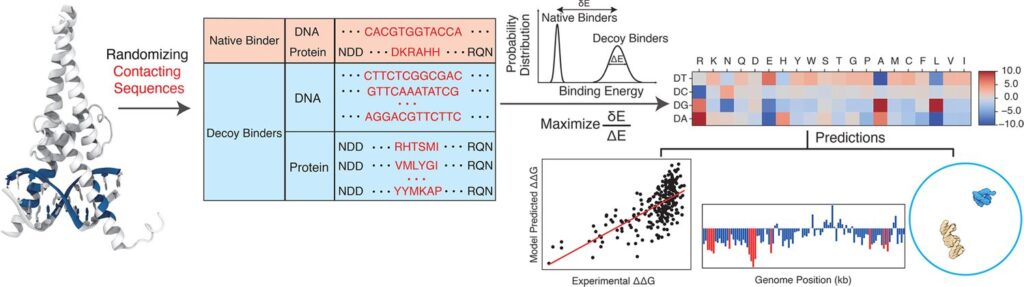
Abstract: Sequence-specific DNA recognition underlies essential processes in gene regulation, yet methods for simultaneous predictions of genomic DNA recognition sites and their binding affinity remain lacking. Here, we present the Interpretable protein-DNA Energy Associative (IDEA) model, a residue-level, interpretable biophysical model capable of predicting binding sites and affinities of DNA-binding proteins. By fusing structures and sequences of known protein-DNA complexes into an optimized energy model, IDEA enables direct interpretation of physicochemical interactions among individual amino acids and nucleotides. We demonstrate that this energy model can accurately predict DNA recognition sites and their binding strengths across various protein families. Additionally, the IDEA model is integrated into a coarse-grained simulation framework that quantitatively captures the absolute protein-DNA binding free energies. Overall, IDEA provides an integrated computational platform that alleviates experimental costs and biases in assessing DNA recognition and can be utilized for mechanistic studies of various DNA-recognition processes.
- Characterizing DNA recognition preferences of transcription factors using global couplings and high-throughput sequencing. Qin Zhou, Jose Alberto de la Paz, Alexander D Stanowick, Xingcheng Lin, Faruck Morcos. Nucleic Acids Research, Volume 53, Issue 12, 8 July 2025. DOI: doi.org/10.1093/nar/gkaf592.
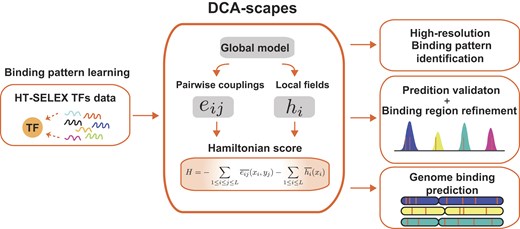
Abstract: DNA–transcription factor (TF) interactions are essential for gene regulation. Fully characterizing TF recognition specificities and identifying their genomic binding targets are important to understand TF function and regulatory networks. Recently, high-throughput sequencing technology HT-SELEX (high-throughput systematic evolution of ligands by exponential enrichment) has been used to measure hundreds of TFs, providing massive datasets that comprise TF binding preferences. However, there is a need to develop comprehensive computational modeling to fully extract and characterize critical TF binding preferences and fail to distinguish genome-wide binding targets. In this study, we developed a global pairwise model called DCA-Scapes trained with experimental HT-SELEX data. Our approach uncovered high-resolution TF recognition specificity landscapes, enabled the prediction of in vivo binding sequences, and was validated with ChIP-seq (ChIP sequencing) data. In addition, the DCA-Scapes model was utilized to refine the locations of binding regions and accurately identify the binding sites within the ChIP-seq enriched peaks. Moreover, we extended our model to cover the entire human genome, uncovering potential TF target sites that exhibit tissue-specific TF recognition across various cellular environments.